

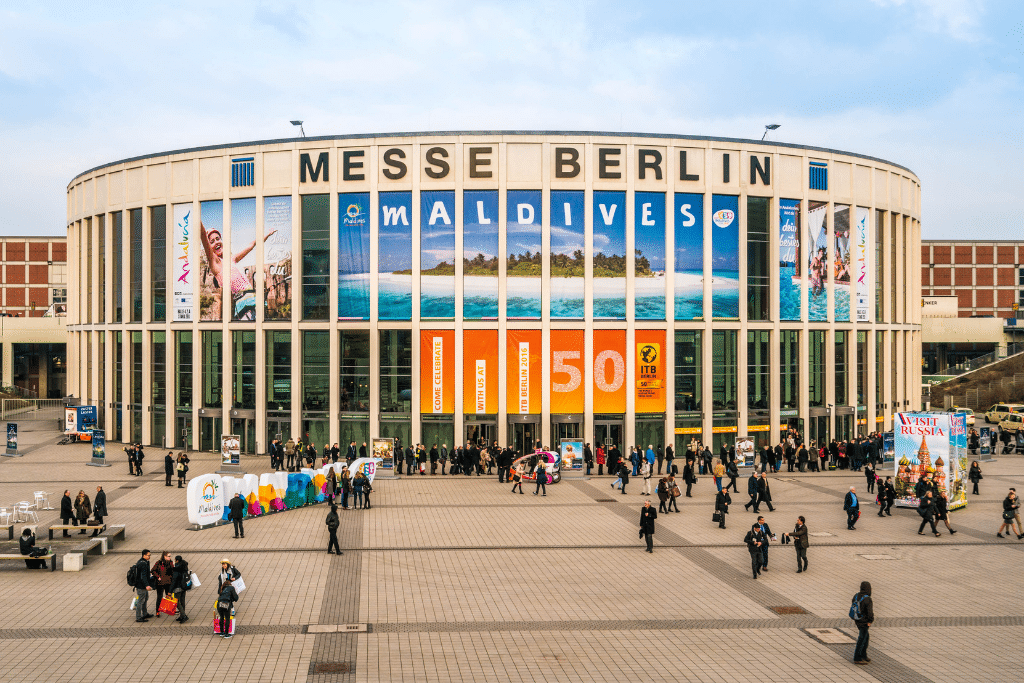
Berlin, early March.
Three days.
Thousands of meetings.
A world condensed into exhibition halls.
That is the first impression ITB Berlin leaves behind.
For a few days each year, Messe Berlin becomes something close to a physical map of the travel industry. Tourism boards, airlines, hotel groups, tour operators, destinations, tech companies, outdoor specialists and media all gather in the same place. You move from one hall to another and the geography keeps changing: mountain regions, coastal destinations, city marketing teams, booking platforms, sustainability experts, travel startups, public institutions.
In 2026, ITB Berlin had extra weight. This year marked the fair’s 60th anniversary, a reminder of how long the event has been acting as a barometer for the global tourism sector. According to the organisers, the show brought together 5,601 exhibitors from 166 countries and territories and nearly 97,000 attendees over three days. ITB also states that deals and purchasing decisions worth €47 billion were made during the trade show, underlining how central the event remains for face-to-face business in tourism.
For us, the trip was both practical and revealing. Quentin, my associate, and Weronika, a film director we work with from time to time, came along to Berlin. The goal was simple enough: meet regular clients, open new conversations, understand how the market is moving, and spend time inside the ecosystem rather than commenting on it from a distance.
That is still one of the clearest lessons of ITB.
You can read trends online.
You can only feel an industry on the ground.
Why ITB Berlin still matters
It would be easy to assume that a trade fair is losing relevance in an industry now driven by digital platforms, remote meetings and algorithmic planning. But tourism remains a sector where relationships, trust and positioning are still built in person.
That is exactly why ITB keeps its influence. It is not just a place where destinations display themselves. It is where they compare notes, test ideas, observe competitors and hear directly how buyers, partners and operators are interpreting the year ahead. The event’s official positioning reflects that role: a leading B2B platform for international dialogue, market access and strategic discussion around the future of tourism.
The convention side of the fair reinforces that. ITB Berlin 2026 ran alongside a conference program with more than 400 speakers, across 17 thematic tracks on four stages, under the theme “Leading Tourism into Balance.” The official program focused heavily on artificial intelligence, geopolitical uncertainty, sustainability and new business models. Speakers and companies highlighted by ITB included executives from Google, Microsoft, Expedia and Airbnb.
That matters, because the fair is not only a marketplace. It is also a filter. If certain subjects dominate the conference agenda in Berlin, it usually means they are no longer peripheral. They have already reached the operational center of the industry.
A sector that has recovered, but not returned unchanged
The broader context helps explain why the conversations in Berlin felt so dense this year.
According to UN Tourism, international tourist arrivals grew by 4% in 2025, reaching an estimated 1.52 billion international tourists worldwide. That made 2025 a new record year in the post-pandemic period. Europe remained the world’s largest destination region, with 793 million international tourists in 2025, up 4% on 2024 and 6% above 2019. UN Tourism also estimates that international tourism receipts reached USD 1.9 trillion in 2025, while total export revenues from tourism, including passenger transport, reached USD 2.2 trillion.
So yes, the sector has recovered strongly.
But recovery is not the same thing as stability.
UN Tourism’s outlook for 2026 is more measured: expected growth of 3% to 4%, assuming continued recovery in Asia and the Pacific, easing inflation in tourism services, and no major escalation in geopolitical conflicts. That wording is important. It suggests that tourism is growing again, but in a more fragile environment than before.
The economic weight of the sector remains enormous. WTTC states that in 2024, travel and tourism contributed US$10.9 trillion to global GDP, or 10% of the global economy, and supported 357 million jobs worldwide. International visitor spending reached US$1.9 trillion in 2024, while domestic visitor spending reached US$5.3 trillion.
These are not decorative figures. They explain why so many destinations, brands and regional actors invest heavily in events like ITB. Tourism is not a niche communication sector. It is a major economic field, with political, environmental and cultural consequences.
What becomes visible when you walk the fair
A fair like ITB is too large to summarize honestly in a neat list of trends. But after enough walking, conversations and observation, a few things become hard to miss.
The first is scale. You do not really understand the event until your body starts keeping score. Around 30,000 steps a day is not a metaphor. It is what happens when meetings are spread across halls, national pavilions, conference stages and informal coffee points. By the end of the day, the fair feels less like a venue than a temporary city.
The second is segmentation. ITB is structured by geography, but also by market logic: regions, niches, technologies, travel styles, distribution models. That organisation makes one thing clear very quickly: tourism is not one market. It is a mosaic of overlapping realities. Adventure travel does not speak the same language as luxury hospitality. Regional tourism boards do not frame their priorities the same way online booking platforms do. Yet they all meet here because they are tied to the same movement of people, attention and capital.
The third is tone. Compared with smaller or more locally anchored trade fairs, ITB feels more openly international and more strategic. The event is not only about selling a destination. It is about reading the global picture. That is part of what makes it useful. A fair in Paris might be easier, closer, culturally familiar. Berlin forces a wider lens.
And that wider lens matters.
Because tourism is changing again.
AI, sustainability and the end of easy messaging
One of the clearest signals at ITB Berlin 2026 was the extent to which AI in tourism has moved from curiosity to operating topic. The official convention program placed artificial intelligence at the center of multiple sessions, from process optimisation to changes in traveller search and booking behaviour. Google executives Yannis Simaiakis and Anna Sawbridge were specifically highlighted by ITB for discussing how search and booking behaviour are evolving in an AI-driven environment. Airbnb co-founder Nathan Blecharczyk was also announced as part of the discussion on how nature tourism and short-term rentals may shape the next era of travel.
This is not a minor shift for tourism communication.
If AI changes how people discover places, compare destinations or plan journeys, then the entire chain of destination visibility changes with it. Search, recommendation, planning and conversion all become more fluid. That raises a serious question for destinations and tourism brands: what kind of content will still matter when discovery becomes increasingly mediated by AI tools?
At the same time, sustainability was not treated as a branding accessory. It was embedded in the event’s official framing and in broader industry data. UN Tourism’s 2026 barometer makes clear that growth is continuing, but so is pressure: Europe remains strong, tourism receipts are rising, and destinations are increasingly dealing with the consequences of success.
That has direct consequences for storytelling.
For years, tourism communication could rely on a simple formula: beautify the place, idealise the experience, reduce friction, increase desire.
That model still exists.
But it is aging.
More and more destinations are trying to move from pure attraction to more selective positioning. Not just “come here,” but “understand what this place is, what it can hold, and what kind of experience belongs here.” The shift is subtle, but real. In mature destinations especially, the challenge is no longer only visibility. It is fit. Seasonality. Flow. Meaning. Responsibility.
What this means for destination storytelling
This is where the fair becomes particularly interesting for a studio like ours.
Atlasta sits between advertising and documentary. That position makes sense in tourism because the sector increasingly needs both: strategic clarity and grounded observation. The best tourism films are rarely the ones that invent a place from scratch. They are the ones that recognise what is already there, then shape a perspective around it.
That may sound obvious. In practice, it is not.
A lot of destination communication still defaults to generic visual language: drone shots, smiles, sunsets, lifestyle fragments detached from context. The result is often interchangeable. Beautiful, perhaps. Memorable, less often.
The more crowded the market becomes, the weaker that approach gets.
UN Tourism’s latest figures show continued worldwide growth, with Europe alone welcoming 793 million international tourists in 2025. In that context, visibility is not enough. Destinations are competing not only for attention, but for relevance.
That is why field-based storytelling matters more than ever.
Not because “authenticity” is fashionable. The word has already been used to exhaustion.
Because tourism is an industry built on representation. And representation has consequences. It shapes expectations, visitor behaviour and even the way local realities are filtered for external audiences.
A tourism film does not just show a destination.
It teaches people how to look at it.
That responsibility is one of the reasons a fair like ITB remains worth attending. It gives you a direct view of how destinations are presenting themselves, what they are afraid of, what they are investing in, and which narratives are starting to lose their force.
Berlin, as backdrop and signal
There is also something fitting about Berlin as host city.
ITB could happen in many places, but Berlin adds its own layer. It is a city shaped by movement, fracture, reinvention and coexistence. During the fair, that atmosphere becomes more visible. Languages overlap. Agendas collide. The city absorbs the event and extends it after hours, in restaurants, lobbies, bars and late conversations that start as logistics and end as market analysis.
That part matters too.
Trade fairs do business during the day.
They reveal people at night.
For us, that was part of the value of the trip. Not just the scheduled meetings, but the texture around them. Seeing how contacts move, how quickly the European market overlaps, how naturally a French producer, a Polish director and partners from other countries can operate within the same circulation of projects and conversations. That international dimension cannot be claimed abstractly. It has to be lived, then made visible.
What remains after three days
By the end of ITB Berlin 2026, the headline numbers still impress: 5,601 exhibitors, 166 countries and territories, nearly 97,000 attendees, €47 billion in deals and purchasing decisions according to the organisers. But the deeper value of the fair is not numerical. It is a diagnostic. It tells you what the industry is prioritising now.
This year, the picture was clear enough.
Global tourism is strong again, but more exposed. AI is no longer peripheral. Sustainability is no longer optional language. And destination storytelling is under pressure to become more precise, more responsible and more differentiated.
That is good news for anyone who believes places deserve better than generic content.
And that is probably the real lesson of Berlin.
Not that tourism is growing. We already knew that.
But that the way places are told — and sold — is changing again.
For three days, the whole sector was there.
Not to invent a future from nothing.
To read what is already happening.
Stories rarely begin in conference halls.
They begin somewhere else.
On the ground.
Still watching?
Look closer.